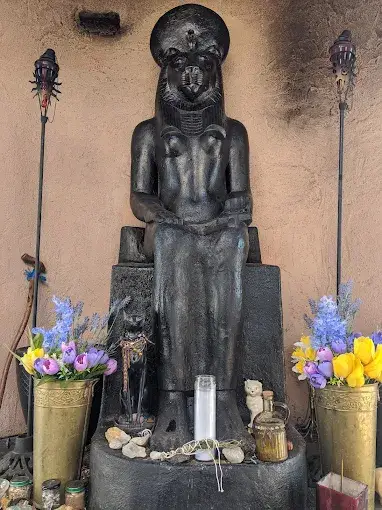
Sekhmet
Sekhmet is one of the most powerful and feared deities in ancient Egyptian religion. Known as the lioness goddess of war, plague, healing, and divine retribution, she embodied the destructive and purifying force of sacred fire. Closely associated with the sun god Ra, Sekhmet is believed to act as his fiery manifestation—a living flame unleashed to defend cosmic order (maat) against chaos.
Sacred fire, in Sekhmet’s mythology, symbolized solar heat, divine wrath, purification, and transformation, making her one of the clearest embodiments of fire imagery in Egyptian theology. Sekhmet’s most important role is the Eye of Ra, a divine force sent forth to act on Ra’s behalf. The Eye of Ra is frequently described in fiery terms—burning, scorching, and annihilating enemies of the gods. Sekhmet’s name itself means “The Powerful One”, and her lioness form symbolized the blazing heat of the midday sun, particularly during the hottest and most dangerous months of the year.

Egyptian texts describe Sekhmet as: “She before whom evil trembles”, “The flame that devours rebels”, and “The fiery breath of Ra”. These titles emphasize her identity as living sacred fire, not merely a warrior goddess. Sekhmet’s strongest association with sacred fire appears in the myth known as The Destruction of Mankind, preserved in New Kingdom temple inscriptions and funerary texts. In this myth humanity rebels against Ra causing Ra to send Sekhmet as his eye to punish them. Sekhmet slaughters and burns humans in her rage. Texts describe her as scorching the land, wading through blood like fire sweeping across dry grass. Her fury is solar and purifying—meant to cleanse the world of disorder. Only when Ra intervenes and intoxicates her with red beer (mistaken for blood) does the fire subside, transforming Sekhmet’s destructive flame into a calmer, life-preserving force associated with Hathor.
This myth illustrates a key Egyptian concept: fire is both necessary and dangerous, capable of restoring balance or destroying the world if unchecked. Sekhmet was also believed to send plagues, which Egyptians understood as manifestations of burning divine heat entering the body. Epidemics, fevers, and sudden illness were attributed to her fiery breath or arrows. At the same time, Sekhmet was paradoxically a goddess of healing. Priests of Sekhmet were trained physicians who worked rituals of fire, incense, and spoken spells to “cool” her rage. Healing was seen as calming divine fire, not eliminating it thus, sacred fire under Sekhmet had a dual nature. Uncontrolled fire caused destruction and disease while her controlled fire purified, healed, and protected.
Sekhmet was especially worshipped in Memphis, where she formed a triad with Ptah (creator god) and Nefertem (lotus and rebirth). Her temples emphasized rituals of appeasement, intended to prevent her fire from erupting catastrophically.
Fire-related elements in her worship included: Lamps and torches representing solar flame, incense as refined sacred fire, and daily recitations to “cool Sekhmet’s heart”. More than 700 statues of Sekhmet were erected by Amenhotep III, likely as part of rituals meant to restrain her destructive power and channel her fire into protection and healing. In Egyptian theology, fire was not evil—it was essential. Sekhmet’s sacred fire defended Ra during his nightly journey through the underworld. Her fire burns the enemies of order in the afterlife and purifies the cosmos so rebirth can occur. Without Sekhmet’s fire, chaos (isfet) would overwhelm creation. She is terrifying precisely because she is necessary.
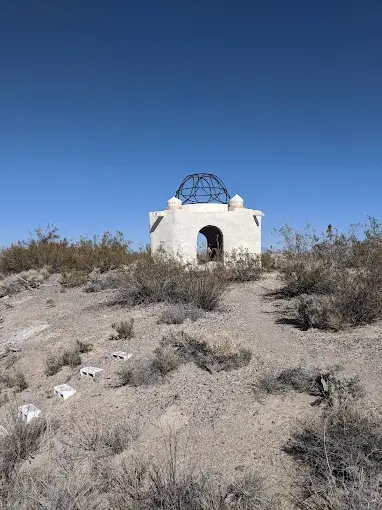
In Indian Springs NV, about a 20 minute drive from Las Vegas stands a Goddess Temple dedicated to Sekhmet. 28425 Hwy 95, Indian Springs, NV 89018
References:
- Encyclopedia Britannica, “Sekhmet”
- Erik Hornung, Conceptions of God in Ancient Egypt
- Geraldine Pinch, Egyptian Mythology
- Jan Assmann, The Search for God in Ancient Egypt
-
Richard H. Wilkinson, The Complete Gods and Goddesses of Ancient Egypt
-
The Destruction of Mankind (New Kingdom temple inscriptions)
-
The Book of the Dead
-
The Amduat
Photo of Sekhmet and Temple by David Lebarron