

Sacred Fire In Wicca
Wicca, a modern Pagan religion emerging in Britain during the mid-twentieth century, places significant emphasis on elemental symbolism. Among the four classical elements (Earth, Air, Fire, Water) and the fifth element (Spirit), fire holds a particularly dynamic position. Fire is associated with purification, passion, transformation, protection, and the presence of the Goddess and God in ritual space. Gerald Gardner’s early writings (1954, 1959) describe fire as both a practical tool of magic and a symbolic gateway to the divine. Later authors, such as Doreen Valiente and Starhawk, expand on fire’s role in personal empowerment and magical intention.
The symbol of sacred fire plays a central role in Wiccan ritual, theology, and cosmology. As one of the classical elements of Western esotericism, fire embodies transformation, will, purification, and the presence of the divine. We find the function of sacred fire in Wicca through ritual, drawing on the works of foundational Wiccan figures such as Gerald Gardner, Doreen Valiente, Janet and Stewart Farrar, Starhawk, and academic researchers such as Ronald Hutton. The analysis demonstrates that sacred fire operates both as a literal ritual technology—through candles, bonfires, and hearth traditions—and as a metaphysical symbol of inner illumination and magical will,

Wicca and Sacred Fire Connection
Wicca draws inspiration from a wide range of pre-Christian European traditions, including Celtic, Anglo-Saxon, and continental practices. Seasonal fire festivals—such as Beltane and Samhain—are documented in historical and folkloric sources and serve as antecedents to modern Wiccan fire rites. Ronald Hutton notes that fire rituals were central to these festivals, functioning as acts of purification, communal bonding, and magical protection. Wicca also inherits fire symbolism from Western occultism and ceremonial magic. Fire corresponds to the southern quarter, the wand or athame (depending on the tradition), and the qualities of will, energy, and transformation. While Wicca is distinct from Hermetic ceremonial magic, it adopts and reinterprets its elemental correspondences.
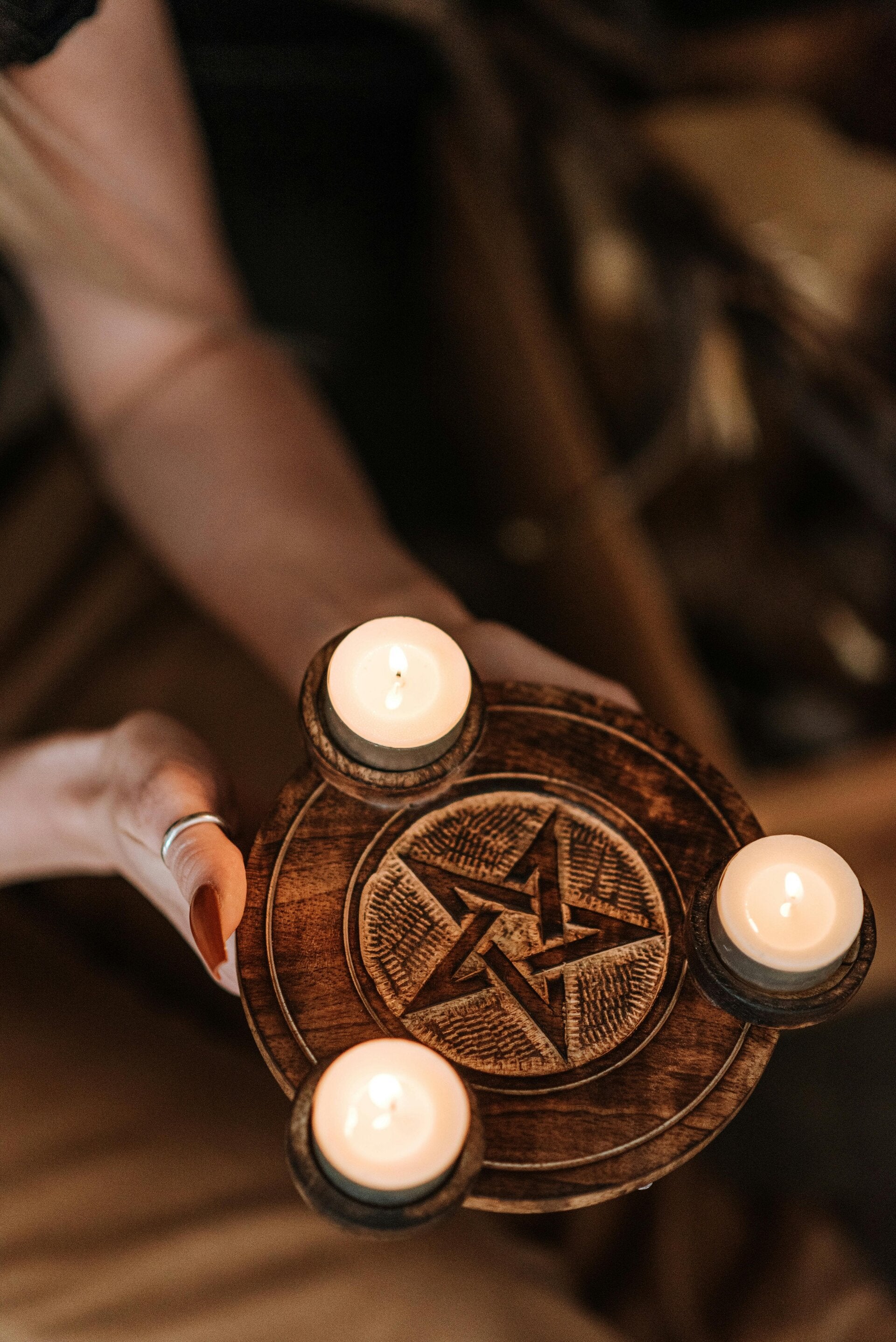
Margaret Murray’s now-discredited “witch-cult hypothesis” nevertheless influenced early Wiccan symbolism. Fire, as a symbol of hidden gatherings and nocturnal rites, appears in both Murray’s accounts and subsequent Wiccan narratives. Gardner’s work adapts these ideas, integrating fire as a symbol of the Old Religion’s continuity. Although Wiccans typically cast circles using an athame or wand, fire is almost always present in the ritual space, whether as candles representing the quarters or as a central altar flame. Fire symbolizes the activation of sacred space and the invocation of divine presence.
Two of the eight Sabbats emphasize fire most strongly:
-
Beltane (May 1): fire represents fertility, vitality, and the union of the God and Goddess. Traditional Beltane bonfires are re-created or symbolically referenced in Wiccan rites.
-
Samhain (Oct 31): fire acts as a guiding light for spirits and ancestors and serves as a protective boundary during the thinning of the veil.
Both festivals align with historical Celtic fire customs described by Hutton and Frazer, though Wicca reinterprets them within a modern Pagan framework. In Texas groups like Council of Magical Arts, nofor over 25 years have held these rites. Fire circles—communal gatherings around a ritual fire—serve as sites of bonding, storytelling, music, and magical working. Sociologically, fire acts as a nucleus of shared identity.
Fire is used in spells for: purification (burning herbs or petitions), activation of sigils, consecration of tools, transformation (burning limiting beliefs or old habits), protection (candle wards and flame-based charms). Janet and Stewart Farrar note that fire is often associated with the will in magical workings, reflecting the practitioner’s intent. The presence of fire is understood as a manifestation of the divine, not merely a symbolic representation. For many Wiccans, the flame is a living presence reflecting the spark of life within all beings. Within Wiccan theology, the Horned God is often associated with sunlight, vitality, and the fire of the sun. In some traditions, fire symbolizes the God’s active, projective force—particularly during Beltane and Midsummer rituals. However, Wiccan theology is non-dogmatic, and associations vary.
The Goddess, especially in her Crone aspect, is sometimes linked to the transformative and destructive aspects of fire—cleansing, renewal, and the final stage of spiritual alchemy. While fire is one of the classical elements, some Wiccan writers (particularly those influenced by feminist spirituality) describe an “inner fire” related to Spirit (Aether). Starhawk’s writings emphasize spiritual empowerment as an inner flame of creativity and intuition. In psychological terms, the Sacred Fire symbolizes the transformative power of intention. Jungian-influenced Wiccan authors view fire as the energy of individuation—the burning away of illusions and the forging of authentic identity. Certain Wiccan rites, especially ecstatic or trance-based traditions, use fire (literal or symbolic) to induce altered states of consciousness. The flickering flame becomes a focal point for meditation, aiding in communion with deities or the collective unconscious.
The Sacred Fire in Wicca functions simultaneously as a symbolic, ritualistic, psychological, and theological force. Its meanings draw on ancient fire cults, Western esoteric traditions, and modern Pagan interpretations. Whether through candle magic, seasonal festivals, or the internal flame of spiritual transformation, fire remains essential to Wiccan identity and practice.
In Wiccan cosmology, fire is not merely an element but a living force—one that purifies, inspires, protects, destroys, and renews. As such, it is inseparable from the religion’s core values of personal empowerment, ecological connection, and reverence for the cycles of nature.
References
-
Hutton, Ronald. The Triumph of the Moon: A History of Modern Pagan Witchcraft. Oxford University Press, 1999.
-
Hutton, Ronald. The Stations of the Sun: A History of the Ritual Year in Britain. Oxford University Press, 1996.
-
Frazer, James. The Golden Bough. Revised edition. Macmillan, 1922.
-
Murray, Margaret. The Witch-Cult in Western Europe. Oxford University Press, 1921. (Influential but academically discredited; relevant to Gardner’s influences)
-
Regardie, Israel. The Golden Dawn. Llewellyn Publications, various editions.
-
Gardner, Gerald. Witchcraft Today. Rider, 1954.
-
Gardner, Gerald. The Meaning of Witchcraft. Aquarian Press, 1959.
-
Valiente, Doreen. The Rebirth of Witchcraft. Phoenix Publishing, 1973.
-
Valiente, Doreen. An ABC of Witchcraft Past and Present. St. Martin’s Press, 1973.
-
Farrar, Janet & Stewart Farrar. A Witches’ Bible: The Complete Witches’ Handbook. Phoenix Publishing, 1981.
-
Starhawk. The Spiral Dance: A Rebirth of the Ancient Religion of the Great Goddess. 1979; revised ed. HarperOne, 1999.
-
Cunningham, Scott. Wicca: A Guide for the Solitary Practitioner. Llewellyn, 1988.
-
Adler, Margot. Drawing Down the Moon. Beacon Press, 1979; revised 2006.