

Torch of Hekate Phosphorus Part 2: Fires of Typhon
“For you cannot be triggered by chaos if you are isolated. Go out, create order out of chaos. Use chaos to move and transform weaknesses that arise to strengths. Honor your chaos and honor me, by organizing it and learning from it. That is my teaching.” – Typhon
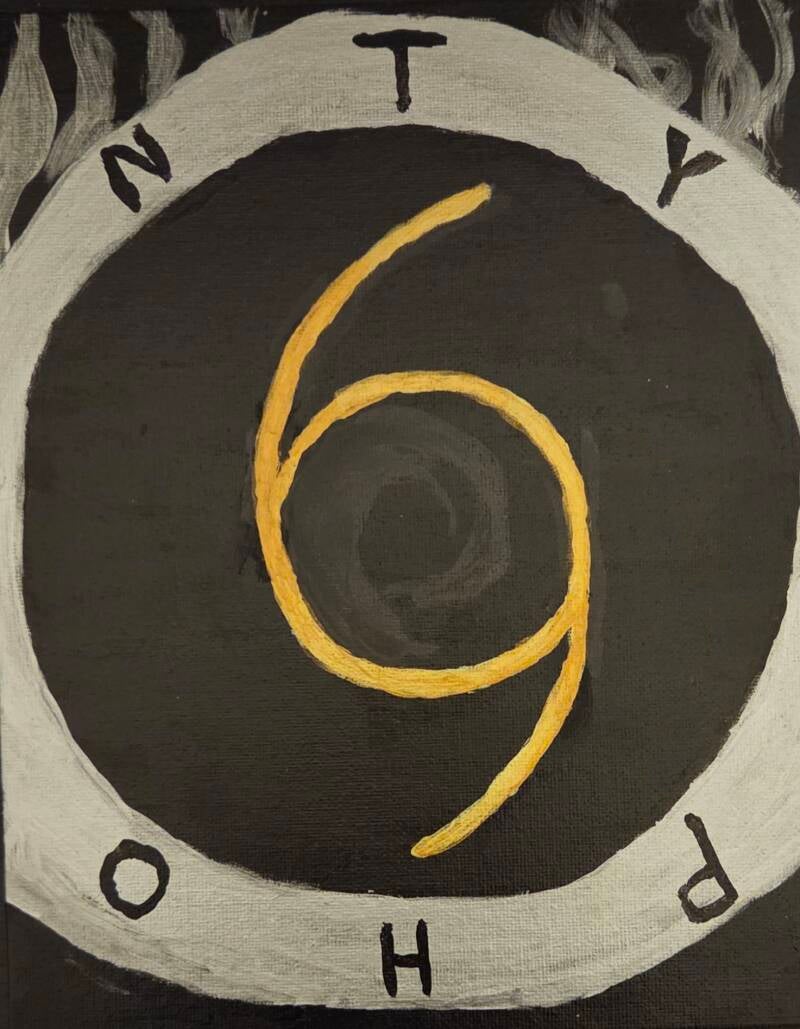
“Where you are headed to work with Typhon. You must see his purpose within you. Learn to love through the chaos of the world. Learn to love though other people’s hatred. This separates you from sheep and wolves nor do you become a sheep or wolf. You become fire, water, earth, and air. You become the wind that howls, the rain, the pounds, the fire that burns. The mighty lightning storm. The elements move for you because your love excites them to do so. The passion you excite them with your song and your heart. Typhon is the chaos, that will help you navigate your own chaos. To be the eye of the storm. Of the heavens you see me. In my guise of lover Selene, the moon in conjunction with the sun. As my orbit calms and moves your seas, my lover gives light and life to your earth. As we circle your world, we govern its flow. It is this celestial aspect that helps govern the flow of Malkuth, the Kingdom and with Queen Naamah, in Nehamoth. This is how I rule in the heavens as it is written. It is the conjunction of the sun and moon in Samael that you will find an alchemy of my energies.” -- Hekate/Hecate
Background
Typhon (also spelled Typhaon or Typhoeus) is one of the most terrifying and powerful figures in Greek mythology. Known as the “Father of Monsters,” Typhon represents primordial chaos, natural catastrophe, and the final challenge to Olympian order—especially to Zeus himself. Typhon was born from Gaia (Earth) and Tartarus, the deep abyss beneath the underworld. His creation was an act of vengeance: Gaia, angered by Zeus’s defeat of the Titans, produced Typhon as the ultimate weapon against the Olympian gods. Typhon later became the mate of Echidna, a half-woman, half-serpent creature. Together, they produced many of Greek mythology’s most infamous monsters, including:
-
Cerberus, the three-headed guard dog of Hades
-
Orthrus, the two-headed dog
-
The Hydra of Lerna
-
The Chimera
-
The Nemean Lion
-
The Sphinx (in some traditions)
Through his offspring, Typhon’s influence extends across much of Greek heroic mythology. Ancient sources describe Typhon as a colossal and horrifying being taller than mountains, with wings that darkened the sky. Hundreds of serpent heads growing from his shoulders and eyes flashing fire. A voice that could sound like roaring beasts, hissing snakes, or thunder. Typhon embodied raw destructive force, often associated with hurricanes, volcanic eruptions, earthquakes, and scorching winds. The most famous myth involving Typhon is his battle with Zeus, one of the greatest confrontations in Greek mythology. In some versions Typhon initially defeats Zeus, tearing out his sinews and hiding them. Zeus is later rescued by Hermes and Pan. Re-armed with thunderbolts, Zeus launches a devastating counterattack.
The final battle ends with Zeus hurling Mount Etna (or another massive mountain) onto Typhon, imprisoning him beneath the earth. Typhon’s struggles are said to cause volcanic eruptions and earthquakes, especially in Sicily. Typhon symbolizes chaos vs. order: the last great threat before Olympian rule is fully secured. All natural disasters such as storms, volcanoes, and seismic destruction. Some scholars see Typhon as a mythological expression of non-Greek or older religious traditions. His defeat reinforces Zeus’s role as a stabilizing force who brings cosmic order to a chaotic universe. Typhon influenced later mythological and religious figures and is linked to Set in Egyptian mythology. He has echoed in later demonological traditions and his name survives linguistically in the word “typhoon,” reflecting his association with violent storms. Although defeated, Typhon is never truly destroyed. His continued presence beneath the earth serves as a reminder that chaos can be suppressed—but never fully eliminated.
Channeled Message from Typhon:
“Do not be afraid, all dragons are shapeshifters. I am seen as a destructive storm that is why my sigil is that of a hurricane. But this is the negative polarity of who I am. The positive is I demonstrate the order of purpose moving through the chaos. My body is the eye of the storm, and my multiple heads create or destroy with purpose as I move. To take on the negative aspects you gain insight into the positive. You will then be able to easily navigate as a force through chaos and creation. Instead of taking my gnosis as a destroyer, use the wisdom I share as a tool to ascend in life. As I move the storms, they come in waves of destruction and creation like the phases of the moon. So, to life. As you work with these currents to make change in your world.
Working with my gnosis, the energies push, pulls, creates, and destroys. But you always come back as I represent the energy in rebirth. The movement of organized chaos in creation, the driving force. By physically working out and challenging yourself you gain my trust. Honoring the chaos that organizes your internal spheres of health. As the eye of the storm, I wield chaos in motion protected and quickly moving. My force is destructive yet purifying. I will expect from those following my gnosis to be strong physically, mentally, and willfully. For I am the ever-flowing current of energy within the winds. My breath moves oceans, and my movement is that of hurricanes. I am the eye of the storm. My wisdom is the key to navigating chaos and through time and space. I am old as time and will be at the end. As I am a shape shifter and often seen as feminine, I am androgenous. As a dual polarity dragon, I create and destroy at once thus becoming a dragon of transformation. The energy is not pleasant at first but purifying in its movements. I am a wind walker and move both on land and sea. My destructive power is to break and mold through fitness of the mind, body, and spirit. My energy once integrated becomes a force in your life. To create or destroy, you choose.
My body as I move is the cycle of energy creating, destroying, purifying, and awakening. As all matters consistently vibrate and moves, my gnosis helps protect yourself from the storms of others. The heads and tendrils help feel energies out to aid in walking peacefully amongst the chaos. Thus, we learn to shape our internal energies to move the same. My currents move through time and space and organize the chaos between the spheres of the Qlipoth and Sephiroth. On the scale of the spiritual macro and microcosm I am a Celestial Dragon organizing the chaos of our planets and the internal/external spheres. The energy moves through the tunnels of Set, which could be why that many associate me with Set. The Yin and Yang energies flowing through the Tree of Death and Life. Again, on the macro level and seeing the trees externally we define the energy organizing and holding it together. Protecting its field with my constant movement.
Thus, taking the name mover of time and space as the Dragon governs the flow of both. On the micro level and the trees internally, we can see this current movement of our body’s growth. In some cases, destructive aging, on the positive the evolution of the mind, body, and spirit. As dragons are primordial sources of power, my function are these currents of organized chaos. I am a gate keeper and protector of the Gate of Gamaliel. As I am the cosmic force flowing so I always knows what flows past all gates. Lilith ruler of this sphere welcomes the ones purified by my force. My boon working with me is to learn that your emotional, mental, and physical strength helps organize your own chaos. This aids in choosing creation or destruction and why it is important to work out. Anger as an emotion is a weakness, yet if channeled properly can be a tool of liberation. Through Lilith’s sexual alchemy you can take the force of anger and transmute it into ascended consciousness. Overcoming the reason for its creation. For anger is unorganized and raises chaotic energy. If not released or transmuted, it can be a destructive force on the internal spheres.
Typhon Praxis:
Purpose: The purpose of this rite is to invoke the fires of Typhon to gain his/her gnosis. Typhon's fire is one of Hecate's keys to the sphere of Gamaliel in the underworld/Qliphoth.
Tools:
Two black tealight/candle
Lancet to anoint the sigil
The Sigil of Hecate (Created by Asenath Mason) and The Sigil of Typhon. It is recommended to draw them on paper or paint them on canvas. Doing so allows your energy to flow into its creation.
Dagger-(Only used for creating the ritual container) Do not use your dagger in the invocations of any of the dragons. How you approach them is how they will approach you and with a dagger can create complications.
Journal
The Invocation
Day 1.
Ritual Prep:
Set up the sigil on an and alter/table facing west and a black tealight next to it. Take a salt shower/bath or ritual bath prior to the invocation. It prepares the mind, body, and spirit for the ritual.
Creating the ritualistic container: Starting in the west and ending in the west making, using a dagger, I would walk counterclockwise drawing the circle. As I walked, I said these words. “I cast this circle of Leviathan around, entwined and bound, above and below to protect the energies so.” Finish by drawing a flaming trident to seal the space.
Ritual:
Light the candle and anoint the sigils with your blood.
Hecate Partial Invocation:
Great Queen of the Night
Keeper of the Keys
Torch Bearing Goddess
Lady of the Crossroads
Heaven, Earth, and Sea
Great Goddess Hecate
Open the gates to the underworld
To the realm of Nehamoth
I partially invoke you from waist to crown
Guide me to the guardian of its gates
So I may learn of your key
to the fire of Typhon
Ho Dracon Ho Megas
En Nomine Draconis
Focus on the sigil for a few minutes. When you have the sigil memorized, close your eyes. See the sigil rise out of the grown in gold and silver with flames wrapping around the edges. See the sigil morph and return to its shape and open. Begin chanting Vovin three times and then Hecate three times. Keep chanting until you feel the energy shift. Sit or lay down and see what comes to you. Write down any experiences in your journal.
Closing:
Call to Hekate/Hecate to guide you back home. See if she has any messages for you.
Once back, say: "It is done"
Leave the candle vigil in honor of Hecate
Cast the sigil of fiery trident in reverse to open the space.
Day 2.
Ritual Prep
Set up the sigils on an and alter/table facing west and a black tealight next to it. Take a salt shower/bath or ritual bath prior to the invocation. It prepares the mind, body, and spirit for the ritual.
Ritual:
Creating the ritualistic container: Starting in the west and ending in the west making, using a dagger, I would walk counterclockwise drawing the circle. As I walked, I said these words. “I cast this circle of Leviathan around, entwined and bound, above and below to protect the energies so.” Finish by drawing a flaming trident to seal the space.
Invocation:
I call thee Great Typhon
Great Cosmic Serpent
Dragon of Primordial Organized Chaos
You who creates and destroys
Mover of time and space
Great Typhon
You who is the eye of the storm
Flowing through all things in constant motion
Androgynous Great Dragon
I invoke you
Enter my Temple of Flesh
And ignite my spirit with your strength and gnosis
I welcome thee to my halls of thought.
Rain Chaos upon my weaknesses
I will transform them to strengths
In your honor of Typhon
Ho Dracon Ho Megas
En Nomine Draconis
Meditation
After you say the words, sit down. Focus on the sigil for a few minutes. When you have the sigil memorized, close your eyes. See the sigil rise out of the grown in gold and silver with flames wrapping around the edges. See the sigil morph and return to its shape and open. Begin chanting Vovin three times and then Typhon three times. Keep chanting until you feel the energies shift. If accepted Typhon will request you to sit with your left hand up and your right hand down. As you do, feel energy pouring into your body through your left hand and out your right. Turn you right hand up. With both hands facing upward, feel energy rising from both. The transference was complete. Allow any experience to unfold.
As Typhon is the guardian to the gate of Gamaliel ruled by Eiseth Zunium/Lilith, if she approaches and asking for intention, specify your intent to learn of Typhon's fire. Let the experience unfold.
Inner Temple Meditation:
See before you a black door with a silver handle. You have seen this door before, it is to your temple door. Open the door and step in. The torch light flickers on the wall as you see your table, chair and mirror. In the center of the room you see your source flame burning bright.. Walk toward it and take a log and place it on the flames. As you do this, the torches on the walls flare up and back down. Turn to the left corner of the room. You see stairs going down into the ground. Next to the stairs is a doorway to another room. Walk into the room. Small torches line the wall. Looking at them, each torch has a frame of a dragon. The light in the room is coming from a fire pit in the middle of the room and Leviathans torch. You see logs next to the fire. Take one and say the name Typhon and place it on the fire. This action causes one of the torches to ignite. If Typhon appears, allow the experience to unfold.
Come back here to care for the flame by adding logs to it. You will find the more you do, the more you sense your own energy as well as Typhon. Know from this day Typhon walks with you
Closing:
Call to Hekate and ask her to guide you back. Ask if she has any messages.
Leave the candle burning as a vigil to Typhon.
Say: "It is done."
Draw the flaming trident upside down to open the space.
References
-
Apollodorus, Bibliotheca (1.6.3)
- Burkert, Walter. Greek Religion
- Gantz, Timothy. Early Greek Myth
- Hesiod, Theogony (lines 820–880)
- Morford, M., Lenardon, R., & Sham, M. Classical Mythology
- Nonnus, Dionysiaca (Books 1–2)
-
Pindar, Pythian Odes (especially Pythian 1)