

Torch of Hecate/Hekate Phosphorus Part 7: Fire of Dagon
“I cannot think of the deep sea without shuddering at the nameless things that may at this very moment be crawling
and floundering on its slimy bed...” ― H.P. Lovecraft
Background
Dagon was a prominent deity in the ancient Near East, worshiped by several Semitic cultures from at least the third millennium BCE. He is most famously associated with the Philistines in the Hebrew Bible, but archaeological and textual evidence shows that his cult was widespread long before Philistine settlement in the Levant. Dagon’s character evolved over time, reflecting regional religious practices and political shifts. The earliest known references to Dagon appear in texts from Ebla (modern Tell Mardikh in Syria), dating to around 2500 BCE. In these texts, Dagon is depicted as a major god, possibly associated with agriculture and fertility. His name is often linked to the Semitic root dgn, meaning “grain,” suggesting an original role as a grain or harvest deity.
In Mesopotamian traditions, Dagon was revered by the Amorites and sometimes identified as the father of the storm god Hadad (Adad). Temples dedicated to Dagon have been uncovered in ancient cities such as Mari and Ugarit, confirming his importance across Syria and Mesopotamia. Dagon is best known today through biblical accounts describing him as the chief god of the Philistines, particularly in cities like Ashdod and Gaza. The Hebrew Bible recounts several confrontations between Dagon and the God of Israel, most notably in 1 Samuel 5, where the Ark of the Covenant is placed in Dagon’s temple. According to the narrative, Dagon’s statue falls and breaks, symbolizing the superiority of Yahweh over Philistine deities.
Contrary to later interpretations, there is little ancient evidence that Dagon was originally a fish god. This misconception likely arose from a folk etymology connecting Dagon’s name with the Hebrew word dag (“fish”). Ancient sources instead portray him primarily as a fertility or storm-related deity. No surviving ancient images definitively depict Dagon, which has contributed to confusion about his appearance. Medieval and early modern writers, as well as modern popular culture, often portrayed Dagon as a half-man, half-fish figure. This imagery was later popularized by H. P. Lovecraft’s 20th-century horror fiction, which bears no historical connection to ancient worship practices. Modern scholarship largely rejects the fish-god interpretation, emphasizing Dagon’s association with agriculture, kingship, and divine authority instead.
The worship of Dagon declined with the fall of Philistine power and the spread of monotheistic religions in the region. By the first millennium BCE, his cult had largely disappeared. Nevertheless, Dagon remains an important figure for understanding the religious landscape of the ancient Near East and the interactions between neighboring cultures. Today, Dagon survives mainly in academic study, biblical scholarship, and popular culture, where his name is often detached from its historical origins.
Dagon Channel
"Welcome to Gaagsheblah. This is a place of purification where the spirits intentions are refined before going through the abyss to become actualized. The energy breaks apart that which was revealed in Golachab to purify. It is this understanding which is the same from Thegarian with the black sun. I am an androgenous water dragon yet also of the stars like Astaroth, this spheres ruler. As Rahab is the fires of transformation, mine is the waters of purification. As the embers burn your skin from Golachab, my waters tear away and rip apart that which does not serve you. This will help prepare you dive into the abyss so that you are cleansed and purified. It is this letting go of the past aspects that fall into the deep to become food for those in its waters.
You must integrate all you can from your learnings with Rahab. The sphere of Gaagsheblah has a strong current that will break you apart, so know all is by design. It is in the polarities of water that the forces of destruction and life flow. These primordial currents carry the essence of life and give its sustenance. From the fires you burn. Like steel is hardened and purified to a solidified essence. It is this purification that gives life from death. I am the cosmic currents on the micro and macro level. Within you is a deep watery abyss that is a well spring. Its currents match my own external forces. Waking this up, helps to understand the watery flow within and to navigate its depths. By doing so you navigate the external. That is the work ahead.
I am not what you think, some serpent of the sea. I am the primordial force of the sea. The movement and breaking down of matter from the water. I am the transition from solid to liquid. Solid is stagnant where liquid moves. Part of the alchemical process. The alchemy of the Qliphoth is to use the Qliphoth like an alchemical tool. This is the “Solve” process for a rebirthing through the abyss. It is in this process we will speak on, as I am a teacher of alchemy in a non-sexual form. It is not the union of opposites but a union of positive and negative. When the aspects of those that are positive things that no longer serve dissolve. This action propels you towards your divine nature. All those who pass through these waters will experience a feeling of loss. This loss are attachments not of external forces but of an internal nature that is removed.
Oceans deep are my oceans, yet the waters are acidic in nature. The fires you hold can only be stripped from my force, know this. Your spirits fire will always be, but the fires of others, the energies of others. Use this sphere and force for cleansing other energies both sexual and non-sexual. This is a place of purification. You can transmute energies but attachments from others can linger. It is here you regain the purity of the ego before its death in the abyss to be reborn into its highest truth, the spirit Daemon. For I am the climax of destruction, the release of suffering. The redemption of damnation through baptismal waters. For I am the destructive force in a Christian baptism stripping away the sins from Golachab that you reclaimed. It might not make sense, but it is truth. The annihilation of the attachments to these sins. You choose then to proceed to the abyss to die and be reborn. The pressure pushes you forward. This is my riddle and my gnosis.
I am the wanderer of the deep that sees all. My tendrils rip apart that which should not be. My mouth devours all that challenge my force. Those that trust my force receive my trust back. Your purposeful design, my purpose in your working. Honor your spirits desire for destruction, so that it me be reborn in Daath. Awake me within and see the destruction unfold not of external but internal. It will be painful for a moment, then the calm before the storm of rebirth. All things given by me are meant for those who wish to release suffering. The waters of life and death are the same. To live you must surrender and let go of what will not let you live. This mentality will help you through the sphere of Gaagsheblah. All who swim in my waters parish but will not die. Its this mystery that is part of the alchemical process. The refining of your light in the waters of the abyss. Like forging a sword, the quench or hardening of the soul. Will you crack or remain solid. This is the challenge of this Qliphoth.

Dagon Praxis
Purpose: The purpose of this rite is to invoke the fires of Dagon to gain his gnosis. Dagon's fire is one of Hecate's keys to the sphere of Samael in the underworld/Qliphoth.
Tools:
Two black tealight/candle
Lancet to anoint the sigil
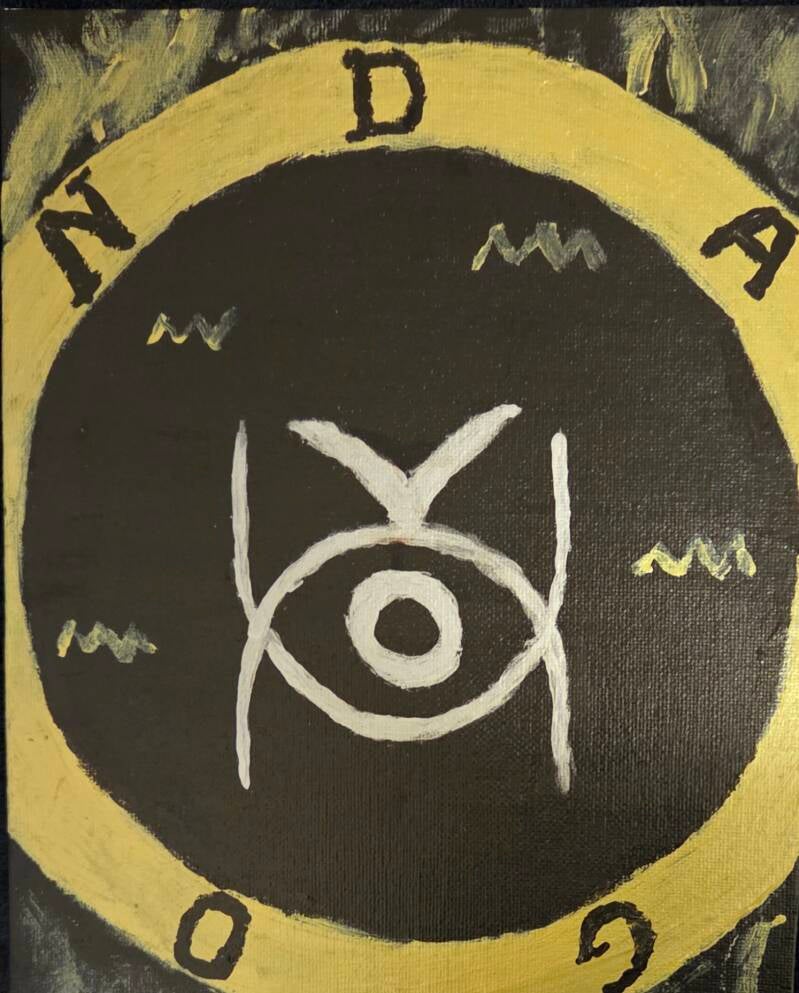
The Sigil of Hecate (Created by Asenath Mason) and The Sigil of Dagon. It is recommended to draw them on paper or paint them on canvas. Doing so allows your energy to flow into its creation.
Dagger-(Only used for creating the ritual container) Do not use your dagger in the invocations of any of the dragons. How you approach them is how they will approach you and with a dagger can create complications.
Journal
The Invocation
Day 1.
Ritual Prep:
Set up the sigils on an and alter/table facing west and a black tealight next to it. Take a salt shower/bath or ritual bath prior to the invocation. It prepares the mind, body, and spirit for the ritual.
Ritual:
Creating the ritualistic container: Starting in the west and ending in the west making, using a dagger, I would walk counterclockwise drawing the circle. As I walked, I said these words. “I cast this circle of Leviathan around, entwined and bound, above and below to protect the energies so.” Finish by drawing a flaming trident to seal the space.
Light the candle and anoint the sigil with your blood
Hecate Partial Invocation:
Great Queen of the Night
Keeper of the Keys
Torch Bearing Goddess
Lady of the Crossroads
Heaven, Earth, and Sea
Great Goddess Hecate
Open the gates to the underworld
To the realm of Aarab Zurcach
I partially invoke you from waist to crown
Guide me to the guardian of its gates
So I may learn of your key
to the fire of Tannin
Ho Dracon Ho Megas
En Nomine Draconis
Meditation:
Focus on the sigil for a few minutes. When you have the sigil memorized, close your eyes. See the sigil rise out of the grown in gold and silver with flames wrapping around the edges. See the sigil morph and return to its shape and open. Begin chanting Vovin three times and then Hecate three times. Keep chanting until you feel the energy shift. Sit or lay down and see what comes to you. Write down any experiences in your journal.
Closing:
Call to Hekate/Hecate to guide you back home. See if she has any messages for you.
Once back, say: "It is done"
Leave the candle vigil in honor of Hecate
Cast the sigil of fiery trident in reverse to open the space.
Day 2
Ritual Prep:
Set up the sigils on an and alter/table facing west and a black tealight next to it. Take a salt shower/bath or ritual bath prior to the invocation. It prepares the mind, body, and spirit for the ritual.
Ritual:
Creating the ritualistic container: Starting in the west and ending in the west making, using a dagger, I would walk counterclockwise drawing the circle. As I walked, I said these words. “I cast this circle of Leviathan around, entwined and bound, above and below to protect the energies so.” Finish by drawing a flaming trident to seal the space.
Light the candle and anoint the sigil with your blood
Ancient one in the deep
Water Serpent and Primordial Force of Gaagshiblah
Great Dagon destroyer and purifier
Androgenous Dragon of Destruction
Who moves the waters of life and death
All who swim through these will parish but not die
Great bestower of purification
I invoke you
Awaken your fire and gnosis within me
Quench my fires of past sins with your sacred waters
Imbue your wisdom of alchemy within me
So, I may carry your wisdom to share to others
In honor of you
Ho Dracon Ho Megas
En Nomine Draconis
Meditation:
After you say the words, sit down. Focus on the sigil for a few minutes. When you have the sigil memorized, close your eyes. See the sigil rise out of the ground in gold and silver with flames wrapping around the edges. See the sigil morph and return to its shape and open. Begin chanting Vovin three times and then Dagon three times. Keep chanting until you feel the energies shift. If accepted Dagon will request you to sit with your left hand up and your right hand down. As you do, feel energy pouring into your body through your left hand and out your right. Turn you right hand up. With both hands facing upward, feel energy rising from both. The transference was complete. Allow any experience to unfold.
Inner Temple Meditation:
See before you a black door with a silver handle. You have seen this door before, it is to your temple door. Open the door and step in. The torch light flickers on the wall as you see your table, chair and mirror. In the center of the room you see your source flame burning bright. Walk toward it and take a log and place it on the flames. As you do this, the torches on the walls flare up and back down. Turn to the left corner of the room. You see stairs going down into the ground. Next to the stairs is a doorway to another room. Walk into the room. Small torches line the wall. Looking at them, each torch has a frame of a dragon. The light in the room is coming from a fire pit in the middle of the room, Leviathan's, Typhon's, Lotan’s, Tannin’s, Tiamat's, and Rahab’s torch. You see logs next to the fire. Take one and say the name Dagon and place it on the fire. This action causes one of the torches to ignite. If Dagon appears, allow the experience to unfold.
Come back here to care for the flame by adding logs to it. You will find the more you do, the more you sense your own energy as well as Dagon. Know from this day Dagon walks with you
Closing:
Call to Hekate/Hecate to guide you back home. See if she has any messages for you.
Once back, say: "It is done"
Leave the candle vigil in honor of Dagon
Cast the sigil of fiery trident in reverse to open the space.
References
- Black, Jeremy & Green, Anthony. Gods, Demons and Symbols of Ancient Mesopotamia. University of Texas Press, 1992.
- Day, John. Yahweh and the Gods and Goddesses of Canaan. Sheffield Academic Press, 2000.
- Hallo, William W. The Context of Scripture, Vol. 1. Brill, 1997.
- Pardee, Dennis. “Dagon” in Dictionary of Deities and Demons in the Bible, edited by Karel van der Toorn et al., Brill, 1999.
-
The Hebrew Bible, 1 Samuel 5; Judges 16.
-
Wyatt, Nicolas. Religious Texts from Ugarit. Sheffield Academic Press, 2002.